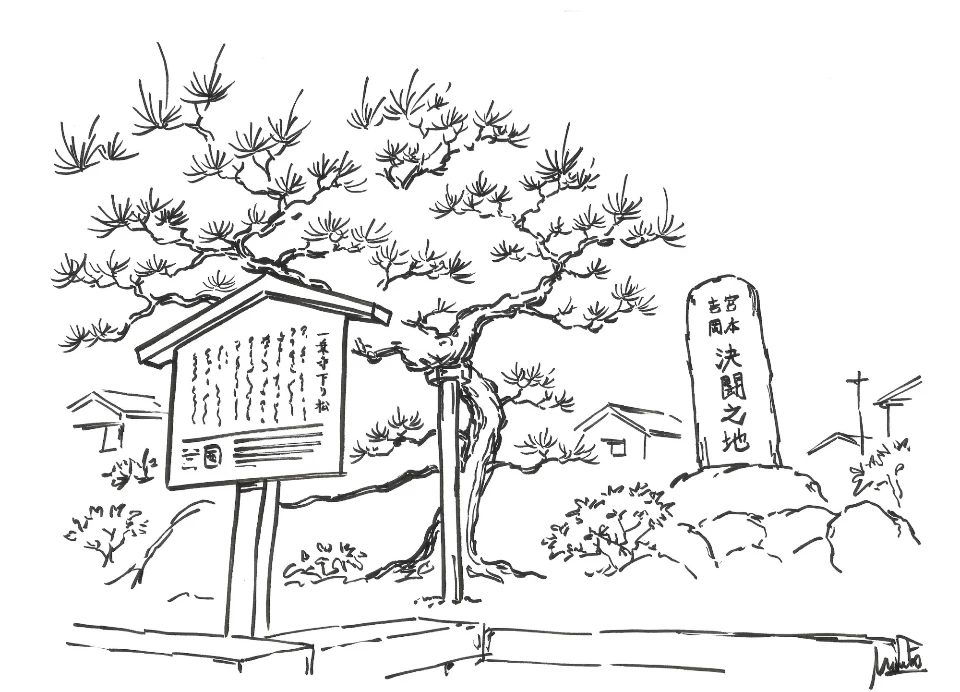
Vagabond · the Ichijōji Sagarimatsu pine and the stone marking the Miyamoto–Yoshioka duel.
Illustration by seichitravel
1 / 1
Sekigahara, Kyoto and Nara
The settings of Takehiko Inoue’s manga in two days from Kyoto: Sekigahara, where the story begins, Sanjūsangen-dō, the former Hōzōin in Nara, the Yagyū valley and the Ichijōji pine, where Musashi takes on the 70 Yoshioka.
Day 1
Sanjūsangen-dō and Sekigahara
Start at Sanjūsangen-dō as soon as it opens (9:00 in winter, 8:30 the rest of the year); an hour is enough. Go back to Kyoto Station and take the train to Sekigahara: you will arrive before noon.
Have lunch in Sekigahara, visit the museum and walk to Mount Sasao. Day 1 cannot be a Monday, when the museum is closed. Back to Kyoto in the afternoon.
1Sanjūsangen-dō · the duel with DenshichirōManga · admission ¥600Context and visit⌄
At Rengeō-in, the temple of the Sanjūsangen-dō hall, Denshichirō Yoshioka fights Musashi to avenge his brother Seijūrō and loses, one of the key duels of the Kyoto arc. The hall is 120 m long and holds 1,001 statues of Kannon; photography is not allowed inside and you take your shoes off. Admission is ¥600. From 16 November to 31 March it opens 9:00–16:00, and 8:30–17:00 the rest of the year; the last tickets are sold 30 min before closing.
2Sekigahara · where the manga beginsManga · museum ¥500Context and visit⌄
The manga begins here, in 1600: Takezō, the future Musashi, and his friend Matahachi, who had left their village dreaming of fortune, end up on the losing side of the Battle of Sekigahara. The battlefield museum (Gifu Sekigahara Battlefield Memorial Museum) explains the battle, and its top-floor viewing deck looks out over the whole valley. Then 15 min on foot (1.1 km), past the site of the decisive fighting, take you to Mount Sasao, where Ishida Mitsunari, leader of the losing side, had his command post. The museum opens 9:30–17:00 (last entry 16:30) and closes on Mondays (the next weekday when Monday is a holiday) and from 29 December to 3 January; admission is ¥500. Photography is not allowed in the ground-floor film room or the first-floor exhibition.
Leave Kyoto around 8:00 to see the Hōzōin marker and catch the 9:20 bus to Yagyū at Kenchō-mae. There is plenty of time there for the temple and the village before the 11:50 or 13:20 bus back.
In the afternoon, back in Kyoto, the day ends with the manga’s most famous duel at Ichijōji and Hachidai Shrine, 5 min apart on foot. Return to the station by city bus.
3Former Hōzōin · the duel with InshunManga · free markerContext and visit⌄
In Nara, Musashi visits Hōzōin, the temple where a famous school of spearmanship was born, and takes on Inshun, its young master. The temple no longer exists: a stone marker on Noborioji street marks the site as the birthplace of the Hōzōin school of the spear. It can be seen from the pavement and is free.
4Yagyū · Sekishūsai’s clanManga · admission ¥200Context and visit⌄
Musashi reaches the Yagyū valley to test himself against the clan and ends up facing the old Yagyū Sekishūsai, while Otsū lives under the family’s protection. The stop is Hōtoku-ji temple, at the top of the village, founded in 1638 by Yagyū Munenori in memory of his father Sekishūsai; behind the temple stand more than 80 graves of the clan. It opens daily 9:00–16:30 and admission is ¥200; from the bus stop it is a 15-min walk uphill.
5Ichijōji Sagarimatsu · Musashi against the 70 YoshiokaManga · freeContext and visit⌄
Vagabond · the Ichijōji Sagarimatsu pine and the stone marking the Miyamoto–Yoshioka duel.
Illustration by seichitravel
The manga’s most famous fight: Musashi alone against the 70 men of the Yoshioka school, who come to avenge Seijūrō and Denshichirō. He wins but comes away with a badly wounded leg. Today’s pine, at a neighbourhood crossroads, is a successor of the original, and a stone marks the site of the duel. It is free: look from the pavement without blocking the way.
6Hachidai Shrine · the original pine and Musashi’s statueTribute · freeContext and visit⌄
A 5-min walk from the pine, this shrine keeps a piece of the trunk of the original Sagarimatsu and has a statue of Musashi. A tradition, which Eiji Yoshikawa’s novel behind the manga takes up, says Musashi passed by before the duel and decided not to pray. It is free.
Color by day · day.stop (1.2 = day 1, stop 2) · × groups nearby points: tap to zoom. KML and GPX contain waypoints, not navigation tracks.
Pins for the temples, battlefield, marker and pine, not exact panels. Exports contain points, not navigation.
Download waypoints
Before you set off
The Sekigahara museum is closed on Mondays (the next weekday when Monday is a holiday) and from 29 December to 3 January, so day 1 cannot fall on those days. Sanjūsangen-dō opens 9:00–16:00 from 16 November to 31 March.
Buses to Yagyū run only a few times a day: check the Nara Kōtsū timetable before you go. The times on the route are those of December 2026.
Temples, a shrine and neighbourhood streets: keep your voice down, do not block the crossroads by the pine and do not photograph anyone without permission.
When to go
The Sekigahara museum is closed on Mondays, so day 1 cannot fall on one. On day 2, take the 9:20 bus to Yagyū; the return leaves at 11:50 or 13:20.
Kyoto Station → Sanjūsangen-dō · the duel with DenshichirōCity bus 100, 206 or 208 from Kyoto Station to the Hakubutsukan Sanjūsangendō-mae stop (¥230 flat fare, about 10 min), right in front of the temple.
City bus · ~15 min · ¥230
Sanjūsangen-dō · the duel with Denshichirō → Sekigahara · where the manga beginsCity bus back to Kyoto Station (¥230, 10 min) and the JR train to Sekigahara, changing at Maibara (¥1,520, about 80 min on the Biwako and Tōkaidō lines). From the station, 10 min on foot (650 m) to the museum.
City bus and JR train · ~110 min · ¥1,750
Sekigahara · where the manga begins → Kyoto StationFrom Mount Sasao, 25 min on foot (1.7 km) to Sekigahara Station, then the JR train to Kyoto, changing at Maibara (¥1,520, about 80 min).
JR train · ~105 min · ¥1,520
Day 2 · Nara, Yagyū and Ichijōji
Kyoto Station → Former Hōzōin · the duel with InshunKintetsu train from Kyoto Station to Kintetsu-Nara (¥760, about 50 min, changing at Yamato-Saidaiji on some trains). From there, 15 min on foot (1.1 km) east.
Kintetsu train · ~70 min · ¥760
Former Hōzōin · the duel with Inshun → Yagyū · Sekishūsai’s clan5 min on foot to the Kenchō-mae stop and Nara Kōtsū bus 94 or 100 to Yagyū (¥1,110, about 40 min). Buses are few: the 9:20 arrives at 10:01, and the return leaves at 11:50, 13:20, around 15:45 and 17:30 (December 2026 timetable). From the stop, 15 min on foot.
Nara Kōtsū bus · ~65 min · ¥1,110
Yagyū · Sekishūsai’s clan → Ichijōji Sagarimatsu · Musashi against the 70 Yoshioka15 min on foot back to the stop and the Nara Kōtsū bus to Kintetsu-Nara (¥1,110, about 45 min). Then Kintetsu to Tambabashi, Keihan to Demachiyanagi and the Eizan train to Ichijōji (¥1,280, about 80 min). From the station, 10 min on foot (700 m).
Bus, Kintetsu, Keihan and Eizan train · ~150 min · ¥2,390
Ichijōji Sagarimatsu · Musashi against the 70 Yoshioka → Hachidai Shrine · the original pine and Musashi’s statueFollow pedestrian crossings and open access. During works, use public streets around the perimeter.
On foot · ~5 min · 400 m
Hachidai Shrine · the original pine and Musashi’s statue → Kyoto Station10 min on foot to the Ichijōji Sagarimatsu-machi stop and city bus 5 to Kyoto Station (¥230 flat fare, about 50 min).
City bus · ~60 min · ¥230
Walking legs between stops add up to about 400 m (~5 min without stops). Transport legs also include the walk to each station, given in their note.
Transport, admission and food
Includes the trains and buses for both days and three admissions: Sanjūsangen-dō (¥600), the Sekigahara museum (¥500) and Hōtoku-ji in Yagyū (¥200). The other stops are free.
Food and drink
¥4,000
¥2,000 a day for food and local expenses; transport and admission are added to the total.
Hotels, shopping and other visits are extra.
Transport · train and bus
¥7,990
Lodging · not included
¥0
Admission · Sanjūsangen-dō, museum and Hōtoku-ji
¥1,300
Food and local expenses · 2 days
¥4,000
Estimated total
¥13,290
Other food and drink allowances
Comfort
Transport · train and bus
¥7,990
Lodging · not included
¥0
Admission · Sanjūsangen-dō, museum and Hōtoku-ji
¥1,300
Food and local expenses · 2 days
¥7,000
Estimated total
¥16,290
More flexibility
Transport · train and bus
¥7,990
Lodging · not included
¥0
Admission · Sanjūsangen-dō, museum and Hōtoku-ji
¥1,300
Food and local expenses · 2 days
¥11,000
Estimated total
¥20,290
Take the route with you
Download the HTML file and open it in your browser to read the itinerary offline. Links to maps and external websites need internet.